How much does water damage restoration cost in Cloverdale?
Most Cloverdale homeowners spend between $1,300 and $5,500 on professional water damage restoration. That covers extraction, drying equipment, antimicrobial treatment, and monitoring over three to five days. Smaller jobs like a clean supply line leak in a single room often land between $800 and $1,800. Larger losses involving a finished basement, multiple rooms, or hardwood floors can run $7,000 to $15,000 or higher once demolition and rebuild are included. Category 3 sewage losses cost more because of disposal requirements and PPE.
The honest answer is that no reputable company can quote a flat number over the phone. Two homes on the same street in Cloverdale can have wildly different bills based on what is wet, how long it has been wet, and what materials were affected. What we can do is give you a written scope and pricing aligned with Xactimate, the same software your insurance adjuster uses.
What factors actually change the price?
Four things drive the cost more than anything else. First is water category. Clean water from a supply line is cheaper to handle than gray water from a washing machine, and both are cheaper than Category 3 sewage. Second is square footage affected, which includes wall cavities and subfloor, not just the visible wet spot. Third is materials. Tile and concrete dry faster than engineered hardwood or carpet with pad. Fourth is how long the water has been sitting. Anything past 48 hours often crosses into mold territory, which adds remediation costs.
Access also matters more than people expect. A second-story leak that soaked into a finished first-floor ceiling requires controlled ceiling removal, containment, and often scaffolding inside the home. A basement with a low-clearance crawl space adds labor hours for every piece of equipment we stage. Stairs, narrow doorways, and built-in cabinetry all change the scope. We have seen two identical 400 square foot losses price out $2,200 apart because one had open access and the other required tearing out custom millwork to reach the wet framing behind it.
If you want the deeper breakdown, our guide on filing a water damage insurance claim walks through how adjusters itemize each of these on your estimate.
How fast can Cloverdale Water Restoration actually be on site?
Our standard response window for Cloverdale and surrounding Central Indiana communities is 60 to 90 minutes, 24 hours a day, seven days a week, including holidays. During regional events like the freeze-thaw cycles we get every February or the summer storm clusters that roll through Marion and Hamilton counties, response can stretch to two or three hours simply because call volume spikes. Even in those windows, we keep you updated by text with a real ETA, not a vague "we will get there."
What matters more than the truck arriving is what you do in the first 30 minutes. Shutting off the water source at the main, killing power to affected circuits, and moving valuables off wet flooring all reduce your final bill. Our breakdown of the first steps after water damage covers exactly what to do before any crew shows up.
What does the restoration process look like day by day?
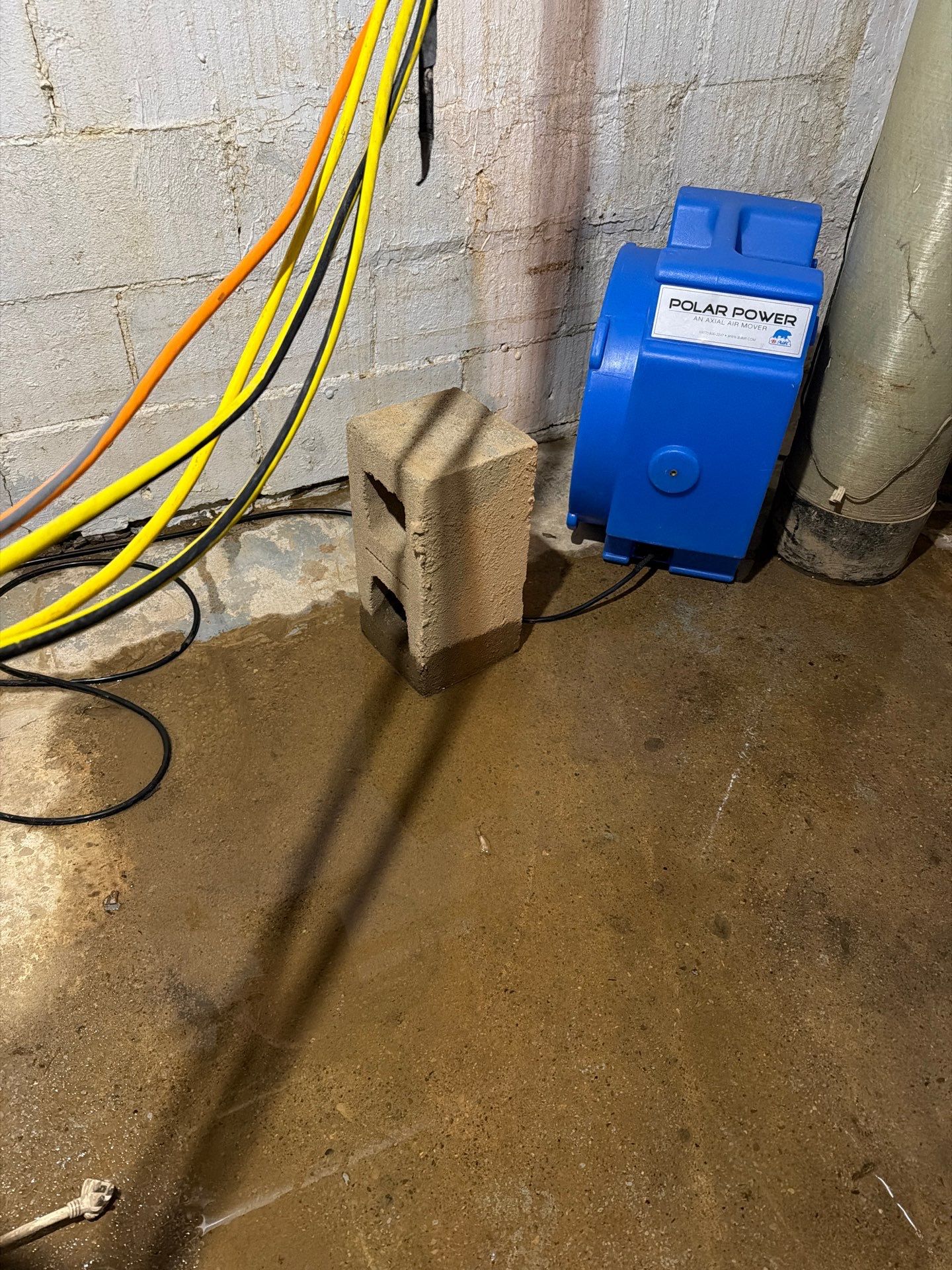
Day one is extraction and assessment. We pull standing water with truck-mounted units, document moisture readings in every affected material, and place air movers and dehumidifiers. You will hear the equipment. It is loud, and it needs to run continuously. Day two through four is active drying. We return daily to take readings, reposition equipment, and remove materials that are not drying (typically wet drywall, soaked carpet pad, or warped baseboards). Day five is usually final verification. Once moisture content matches unaffected areas, equipment comes out and reconstruction can begin.
For finished basements, which are common in Cloverdale neighborhoods built in the 1990s and 2000s, drying often takes longer because vapor barriers trap moisture against concrete. We address this with targeted demolition rather than waiting and hoping.
What happens if I wait or try to dry it myself?
Box fans and open windows do not move enough air to dry structural materials. They feel productive, but inside 48 hours, microbial growth begins in wet drywall and framing. That window is real, and we walked through the biology of it in our post on the 24 to 48 hour mold window. Once mold establishes, you are no longer dealing with a water claim. You are dealing with a remediation project that insurance often pushes back on because of the delay.
The other risk is hidden moisture. Water travels under cabinets, behind baseboards, and into wall cavities you cannot see. Without moisture meters and thermal imaging, you are guessing. We have walked into too many Cloverdale homes six months after a "dried out" leak to find black staining behind drywall and rotted bottom plates.
How do I know if I am dealing with a Category 3 emergency?
Category 3 water is grossly contaminated and includes sewage backups, toilet overflows beyond the bowl, and flood water from outside. It is a health hazard, not just a property issue. Anything Category 3 requires PPE, controlled demolition, and disposal of porous materials that contacted the water. You should not be in the space without protection.
Drywall, carpet, pad, insulation, and particleboard that contacted Category 3 water all come out. They cannot be cleaned and dried back to a safe state. Hard surfaces like sealed concrete, tile, and finished hardwood can often be saved with proper cleaning and antimicrobial application. If you are unsure what category you are dealing with, treat it as Category 3 until a professional confirms otherwise. The cost of being cautious is small compared to the cost of a contamination claim later.
Do you handle commercial properties in Cloverdale?
Yes. We work with property managers, retail tenants, restaurants, medical offices, and small industrial sites across Central Indiana. Commercial losses move fast because every hour of downtime costs revenue, so we scope around your operating hours when possible, including overnight drying and weekend reconstruction phases.
Will my homeowners insurance in Cloverdale cover it?
Sudden and accidental water damage is covered under most standard Indiana homeowners policies. That includes burst pipes, appliance failures, ice dam leaks, and roof leaks from wind damage. What is typically not covered is gradual seepage, long-term leaks you should have noticed, surface flooding from rain or rivers (that needs separate flood insurance), and sewer backup unless you added the rider.
Your deductible usually runs $1,000 to $2,500 in Cloverdale. If your total loss is $3,800 and your deductible is $1,500, the carrier pays $2,300 and you pay the rest. We bill the insurance company directly for the covered portion so you are not floating the full amount on a credit card.
One thing worth knowing: policy limits on water damage are not the same as your dwelling coverage. Many carriers cap mold remediation at $5,000 or $10,000 even if your home is insured for $400,000. That cap is another reason to move fast on the initial drying. Keeping the loss inside the water damage category, rather than letting it grow into a mold claim, protects more of your coverage.